
Review: Bearsden Choir, Glasgow City Halls
City Halls, Glasgow, 23/5/2026
Bearsden Choir (Musical Director Andrew Nunn), McOpera Ensemble, Christopher Nickol (Organ), Soprano Monica McGhee, Baritone Danny Shelvey
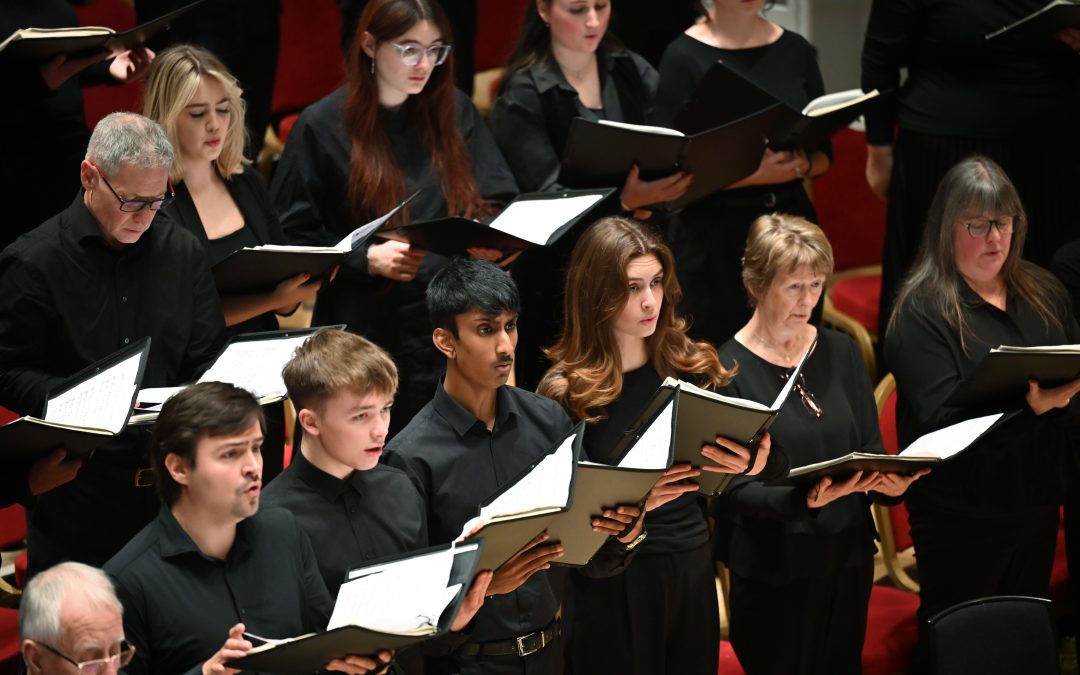
Glasgow City Halls reverberated last Saturday evening as the Bearsden Choir performed a special concert dedicated to the memory of Dr James Hunter, the choir’s director of music for 27 years between 1979 and 2007.
And what a night it was, as the choir – conducted by musical director Andrew Nunn and accompanied by McOpera musicians and two soloists, Scottish soprano Monica McGhee and Liverpudlian baritone Danny Shelvey – performed two pieces that could not have been more different.
The first half featured Vaughan Williams’ cantana Dona Nobis Pacem (Give us Peace), a work written in six continuous movements in 1936 at a time when the country had just come through one world war – and was facing the possibility of another. His texts were taken from the Catholic Mass, three poems written by American poet Walt Whitman, a political speech, and sections of the bible.
Vaughan Williams was in a dark place at the time and this work reflects the horror of war – in parts quiet, emotional and poignant in contrast to the noise of the battlefield. In stark comparison, the second half was Sir John Rutter’s Magnificat, a modern celebratory piece which opens in a joyous, upbeat, syncopated, choral-orchestral rendition of Rutter’s extended biblical canticle in seven movements, beginning with the first three verses of the Virgin Mary’s song of praise from Luke 1: 46-55. Interestingly, Vaughan Williams and Rutter both composed choral settings of the Magnificat.
Rutter’s eclectic music is an easy love and a mainstay of most choirs, particularly at Christmas. Vaughan Williams I am less familiar with, and although I do know some of his church music and have sung a beautiful round of the phrase Dona Nobis Pacem, this was my first introduction to the whole piece.
Dona Nobis Pacem was opened by soloist Monica McGhee, and the first movement Agnus Dei, begins very quietly, then as the choir joins in, builds to a crescendo before falling away – the pattern continues to fade and then soar, punctuated by clashing cymbals and timpani drums driving the rhythm, in contrast to the gentle melody carried by the string section, including a harp.
As the movements in Dona Nobis Pacem are continuous, I found it impossible to detect when one ended and the next started, apart from the second movement Beat! Beat! Drums! based on Whitman’s poem (the three poems were included in the concert programme). And beat they did. I loved the dynamics of this movement, sometimes slow and gradual, and at other times abrupt. The third movement, Reconciliation by Whitman, introduced the baritone soloist, later joined by the soprano soloist as they repeated the phrase Dona, Nobis, Pacem.
The interaction between the choir and the orchestra was superb – the men accompanied by wind instruments and strings and clear separation of the soprano/alto and tenor/bass sections. The choir’s performance was magnificent throughout, their parts distinct yet perfectly balanced. Towards the end it builds, and the tempo escalates – the sound intensifies with drums and cymbals as the soprano voices scaled dizzy heights in a stunning crescendo.
Then it quietened, as the soprano soloist began a cappella and the choir quietly resumed, closing the piece with three Amens – and utter silence prevailed throughout the halls. You could have heard a pin drop before Nunn turned and bowed and as one, the audience made its appreciative response. A short interlude followed.
Starting back, the first movement of Magnificat jauntily sets the scene for the piece as the whole choir sing ‘Magnificat, Magnificat’, together and in parts, followed by a quieter repetition in overlapping parts. The layering of parts was perfection – gentle then rising to full volume, upbeat and building – strings and harp very distinct, culminating in ‘Magnificat!’ which indeed it was.
Each of the seven movements was punctuated by a few seconds of absolute silence. The second movement – a 15th Century poem ‘Of a Rose’ – the ‘rose’ being a metaphor for the Virgin Mary and the incarnation of Christ – saw the choir, with wind and string sections, rising and falling away, the choir parts weaving in and out – and the male parts being frequently singled out. The sound builds again then goes quiet, the sopranos floating above the harmonies anchored by the male parts.
The third movement gave the organ prominence for the first time as the choir and timpani drum step up the volume before going quiet once more. This part also includes a Gregorian chant before it builds in intensity and ends.
Part four begins with the soprano soloist and harp before the choir joins, both perfectly balanced. The male parts have a moment before all parts repeat phases one after another. I particularly liked the fifth movement, Fecit Potentiam, which began with double bass strings and male voices before other parts joined and culminated in a crescendo with clashing cymbals, string plucking, the organ also distinctive.
In the penultimate movement, Esurientes – said to be one of the most beautiful tunes Rutter has ever written – the soprano soloist maintains the narrative with gentle backing from the choir. The harp playing here was beautiful.
Finally, the energy of the first movement returns in a salute to the glory of God, Gloria repeated as the sound increases to three mighty Glorias then descends again before building to a big finish with several Amens. A goose-bump finale called for a well-deserved encore from the audience in the well-filled hall.
This was Bearsden Choir at its absolute finest and Jim Hunter would have been beaming from ear to ear with their performance. The McOpera musicians were outstanding, as were the soloists. As I left the hall, I overheard several people express incredulity at this being an amateur choir. A hugely enjoyable evening was had by all.
Written by Beverly Brown.